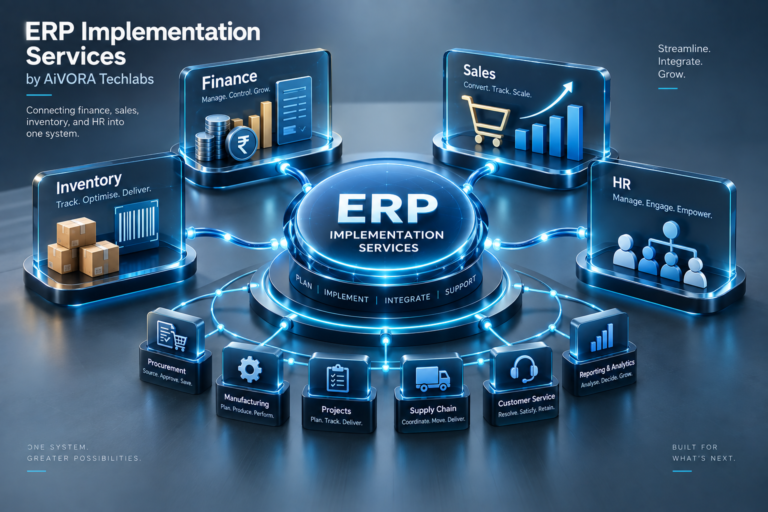
When an Enterprise Resource Planning (ERP) system is deployed merely as an IT upgrade, it forces teams to build workarounds instead of adopting better workflows. True operational excellence requires a partner who aligns technology with your business strategy. Our ERP implementation services bridge the gap between technical capability and everyday execution, ensuring your platform becomes the foundation for scalable growth rather than a bottleneck.
We don’t just configure software; we rewire how your business runs so you can build smarter and scale faster.
A reliable implementation process moves through the same core phases regardless of which platform is involved.
The team maps current workflows, defines scope, and sets measurable goals before any configuration starts.
Future-state processes get designed, and the system gets configured, or built, to match them.
Legacy records move across in two categories.
Customer, vendor, and inventory records fall under master data; open orders and balances fall under transactional data.
A customer’s contact details are master data; their open invoice is transactional data, and both need to be reconciled after migration.
Every workflow, integration, and permission level gets tested end-to-end before go-live, not just the ideal-path scenarios.
Teams train by role, then the system goes live in a controlled cutover with close monitoring in the first weeks.
Issues get resolved, usage gets reviewed, and remaining modules get phased in as the business grows into the system.
AI is moving from a bolt-on feature to part of the implementation scope itself. Vendors increasingly ship embedded AI capabilities inside core ERP modules, which means implementation partners now have to decide, module by module, whether AI features get enabled, customized, or switched off, rather than treating AI as a separate project after go-live.
AiVORA Techlabs’ ERP implementation engagement covers platform selection, process mapping and configuration, data migration, system integration, role-based training, and post-go-live support, run through a four-step delivery model: Discovery, Design & Configuration, Migration & Go-Live, and Optimize. Platform selection is evaluated against process fit and team capacity rather than a fixed product line, including telling a client plainly when a lighter tool would do.
Not every business needs a fully custom build; a standard implementation on a well-fitted platform works for simpler operations. For a deeper look at when a custom build earns its cost and the framework used to decide, see how ERP implementation works.
The businesses that get the most from ERP implementation services treat it as infrastructure built around how they work, backed by a partner who stays involved past go-live.
Talk to a solution architect at AiVORA Techlabs to get your ERP done right.
Book a free consultation